
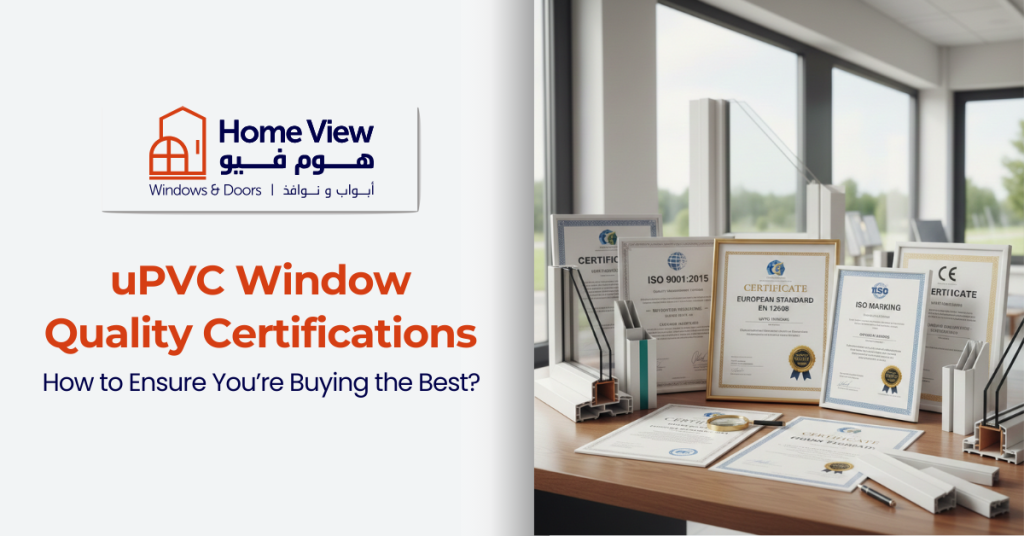
When choosing new windows for your home or commercial building in Saudi Arabia, uPVC window quality certificates, international accreditation standards, and local regulations are all important guarantees of superior performance and longevity.
The harsh Saudi climate, with its strong sun and high coastal salinity, necessitates the use of high-quality materials. Here at Home View Saudi Arabia, we review the most important relevant international certificates (such as ISO 9001, ISO 14001, EN 12608, EN 14351, and CE Marking).
In addition, we review their role in confirming the quality of uPVC windows and how these certificates relate to actual performance characteristics such as thermal insulation, wind resistance, color stability, crack resistance, and safety factors.
International Standards and Quality Certificates for uPVC Windows
ISO 9001 Certification (Quality Management)
It is the global standard for quality management systems, focusing on systematic processes that ensure consistent quality outputs and products that meet customer expectations.
A window manufacturing company obtaining ISO 9001 certification means there is a comprehensive quality control and monitoring system in place, from material selection to the final product, increasing customer confidence that the windows are manufactured according to the highest quality standards.
ISO 14001 Certification (Environmental Management)
When discussing the environment and uPVC, we find this standard dedicated to environmental management systems, confirming that the company implements procedures to protect the environment and reduce waste and energy consumption.
For example, the Belgian company Deceuninck obtained ISO 14001 for its factories, which means that their uPVC window production is carried out according to environmentally friendly operational processes.
Although ISO 14001 is not directly related to the window’s performance on-site, it is an indicator of the company’s commitment to quality and sustainable responsibility, which enhances the reliability of its products.
EN 12608 Standard (Unplasticized PVC Profiles)
This European standard defines the properties and specifications of PVC profiles used in doors and windows. The EN 12608 standard specifies classifications (Classes) for plastic profile quality from A to C based on the thickness of the profile walls.
Class C is the lowest level (no thickness requirements), Class B requires an external surface thickness of ≥2.5 mm, and the highest level is Class A, where the external surface thickness must be at least ≥2.8 mm.
This means that windows manufactured to Class A standards contain thick profiles that better resist wind pressure and twisting. For instance, practical tests have shown that Class A windows have 15-20% higher corner strength and 10-12% less bending under load compared to lower categories.
In short, the higher the PVC profile class certificate, the higher the window’s durability and load-bearing capacity.
EN 14351-1 Standard and CE Marking
The European standard EN 14351-1 is the unified standard for doors and windows (including external windows) regarding their performance characteristics.
Applying this standard qualifies the product for the CE mark in the EU market. This mark means the window has undergone rigorous testing for essential characteristics such as wind resistance, water leakage, and performance reliability.
Consequently, uPVC windows with the CE mark (according to the EN 14351 standard) have proven their ability to perform within approved standard limits.
Furthermore, the manufacturer’s possession of Factory Production Control systems such as ISO 9001 is a prerequisite for obtaining the CE mark, which solidifies the link between production quality and accredited international certifications.
SASO Standards and the Saudi Accreditation Program (SABER)
In the Saudi market, the Saudi Standards, Metrology and Quality Organization (SASO) has issued technical regulations for doors, windows, and their accessories to protect consumers from non-conforming products. These regulations require a Certificate of Conformity (CoC) along with test results proving the safety of materials and their resistance to environmental factors (humidity, salinity, harmful gases).
For example, the Saudi Accreditation Program (SABER) requires the submission of test reports conforming to SASO standards, including analysis of metal content, toxicity, and endurance tests.
In short, required quality certificates in Saudi Arabia are topped by national certificates and standards. Any window carrying the Saudi SABER certificate is suitable for use in the Kingdom, aligning with the Saudi Building Code and consumer safety requirements.
Summary of Key Quality Certificates for uPVC Windows
Below is a table briefly explaining the most prominent international certificates for uPVC windows and what each indicates regarding product quality:
| Certificate | What does it mean simply? | What does it cover? |
| ISO 9001 | International Quality Management System | Control of production processes and customer service |
| ISO 14001 | International Environmental Management System | Company commitment to protecting the environment and reducing waste |
| EN 12608 | Requirements and specifications for PVC window profiles | Quality and strength of PVC profiles (Classes A/B/C) |
| EN 14351-1 (CE) | European standard for window and door performance | Performance tests (wind, water, sound insulation, thermal insulation) with the European CE mark |
| SASO (SABER) | Saudi standard for doors and windows | Product conformity with Saudi safety and quality specifications |
Relationship Between Quality Certificates and Window Performance
International certificates have a direct impact on window characteristics, including:
1- Thermal Insulation
uPVC windows equipped with double or triple glazing are used to maintain a constant temperature inside commercial or residential buildings, which reduces air conditioning and heating consumption.
uPVC is naturally thermally insulating (low thermal conductivity) and does not transfer heat easily. Due to this property, internal surfaces remain cool in summer and warm in winter, enhancing occupant comfort and lowering energy costs.
A window obtaining certificates like EN 14351/CE ensures that tests for glass quality and frame insulation were conducted according to strict standards for protection against external heat.
2- Wind Resistance
Based on the EN 12608 standard, Class A windows are designed to withstand extreme wind force. The thick profiles in Class A require windows to be “tight and stable” even under strong storms.
For example, the German company VEKA states that contemporary windows must remain tightly sealed even under “severe winds and heavy rain.”
When comparing certified windows (made to quality standards) with uncertified ones, we find that the former retain their structural integrity better, while the lower category may cause common uPVC window problems such as air leakage or frame deformation under wind pressure.
3- Color Stability and UV Resistance
Chemical additives (such as Titanium Dioxide) help protect the plastic from ultraviolet rays and prevent color fading. Titanium White (TiO₂) reflects and absorbs harmful rays, preventing the breakdown of chemical bonds within the plastic.
Therefore, windows with quality certificates typically use UV-resistant PVC formulations, maintaining their bright white color without yellowing for many years. (When comparing a certified window to an uncertified one: the former maintains its color, while the other may show slight yellowing after years of sun exposure).
4- Crack Resistance and Durability
Certificates like EN 12608 ensure the use of materials with a precise balance of components (high-quality PVC and stabilizers), giving the window higher resistance to cracking over time.
Due to the large internal wall thickness and manufacturing homogeneity, good windows withstand daily use and operational loads (such as opening and closing hundreds of times) without any cracks appearing.
Studies indicate that high-quality Class A windows require greater force for screw withdrawal and achieve optimal adaptation under pressure compared to lower-quality types, reflecting superior rigidity and durability.
5- Security and Safety
Certified windows also undergo safety tests (such as breakage resistance and intrusion resistance testing according to EN 1627 standards). This means having hinges and locks of approved standards, increasing the window’s safety against burglary attempts.
In short, a certified window provides higher reliability that it will not easily disintegrate under pressure or when seeking shelter.
6- Lifespan
Adherence to quality standards ensures the manufacture of a window with a long service life. For example, certified companies often provide warranties extending for many years, up to 20-30 years for windows.
In contrast, uncertified windows may consume a lot of maintenance, and you might be forced to replace parts within fewer years. (This highlights the importance of investing in certified products in the long run).
Difference Between Certified and Uncertified Windows
The following table shows a simplified comparison of the impact of quality certificates on performance versus uncertified windows:
| Feature | Certified Windows (ISO/EN/CE) | Uncertified Windows |
| Thermal Insulation | High due to double glazing and tight seals | Less effective; increased electricity bills |
| Wind Resistance | Remains tight and stable in storms (Class A) | May leak or deform under pressure |
| Color Stability | UV resistant due to TiO₂ | May gradually yellow in the sun |
| Crack Resistance | High due to material thickness and manufacturing quality | Prone to partial cracking over time |
| Security | Strong certified hinges and locks increase safety | Less resistant to security tests |
| Lifespan | Usually ≥20-30 years with long-term warranty | Shorter, may require replacement parts or frequent maintenance |
How to Choose Certified uPVC Windows?
The presence of internationally and locally recognized quality certificates makes it easier for the Saudi customer to make a confident purchasing decision. uPVC windows are designed to withstand Saudi Arabia’s harsh climate (high heat, humidity, and high atmospheric salinity); therefore, we recommend focusing on certified products that carry international certificates.
The ISO 9001 certificate confirms an integrated factory, ensuring consistent specifications. The EN 12608 certificate ensures the strength and durability of the profiles. The CE mark along with the SABER (SASO) certificate means the window conforms to both European and local safety standards.
In short, certificates tell you that these products have been rigorously tested to suit “desert conditions”; to be capable of insulating high noon heat, maintaining refreshing coolness internally, resisting winter rain, and facing frequent wind and dust storms.
Furthermore, accredited institutions commit to not using harmful materials or heavy metals (lead content analysis is necessary for them, for example!). All these indicators put the buyer’s mind at ease because the product is subject to strict supervision, where no party is allowed to compromise on quality.
Examples of Leading Brands with uPVC Window Quality Certificates
Deceuninck (Belgian)
It holds ISO 9001 for quality systems and ISO 14001 for the environment, and confirms that its profiles named “Zendow” comply with EN 12608-1. This ensures profile dimensional stability and strength.
Winsa (Turkish)
Registered with the Turkish TSE authority and holds ISO 9001 and ISO 14001 certificates, in addition to the TS EN 12608-1 certificate for PVC profiles. Winsa products also obtained the German RAL quality mark, enhancing their credibility.
Other Global Companies
Companies like VEKA and Salamander also manufacture Class A profiles and undergo local and international tests to ensure quality.
These examples confirm that searching for certificates via official websites (or requesting them from the distributor) is an important step before choosing the right uPVC windows for your home. The presence of these certificates distinguishes good products in the showroom and indicates the supplier’s commitment to strict standards.
Frequently Asked Questions About uPVC Window Quality Certificates
What are the specifications of uPVC windows?
Rigid Polyvinyl Chloride (uPVC) frames composed of multi-chamber walls to increase thermal insulation.
Their external wall is often ≥2.8 mm in the highest category (according to the international standard EN 12608). They contain internal metal reinforcements (usually galvanized steel) to enhance rigidity, and rubber seals (such as EPDM) to prevent air and water leakage.
They are usually installed with a double or triple thermal glazing system to raise insulation efficiency, with multi-point hinges and locks to increase security. Their colors and structure are made to withstand harsh climatic factors without periodic uPVC maintenance.
What is uPVC material?
uPVC stands for Unplasticized Polyvinyl Chloride. In other words, it is the known PVC material, but without additives to increase flexibility.
This gives it higher rigidity and strength than soft PVC, with natural resistance to environmental factors (such as rust, corrosion, and chemical wear).
What does the acronym uPVC mean?
uPVC means “Unplasticized Polyvinyl Chloride”, which is pure PVC plastic without plasticizers. It is commonly used to refer to rigid plastic windows.
Are there different grades of uPVC windows?
Yes. According to the European standard EN 12608, PVC profile quality is divided into 3 classifications: C, B, and A.
Class C is the lowest category (no specific thickness requirements), Class B is medium thickness, and Class A is the highest (according to the aforementioned EN 12608 standard, the profile’s external wall thickness should not be less than ≥2.8 mm and the internal wall not less than ≥2.5 mm).
Class A “First Grade” windows are usually of higher durability and insulation compared to the grades that follow, as they contain a larger amount of material (about +14% compared to Class B), making them stiffer and able to withstand higher operational loads.
What is the best brand of uPVC windows?
There is no single “best” brand for everyone, but practically the best in the Saudi market is the brand that combines international quality certificates with suitability for the local climate.
Brands like Deceuninck and Winsa are considered reliable options; because they adopt approved European standards (such as EN 12608 and EN 14351), and provide profiles that withstand the high heat, wind, and humidity prevalent in the Kingdom, especially in coastal areas.
What are the best types of uPVC windows?
The best types of uPVC windows are characterized by:
- Class A profiles according to the European standard EN 12608
- Double or triple glazing with actual thermal insulation
- Multi-point locking system
- Internal steel reinforcements suitable for wide spaces
In terms of design, hinged windows (Tilt & Turn) and sealed sliding windows are among the most practical and widespread types in Saudi homes.
Difference between PVC and uPVC windows?
The fundamental difference between PVC and uPVC is that:
- PVC contains plasticizers that make it softer and less stable.
- uPVC (unplasticized) is more rigid, heat-resistant, and has a longer lifespan.
For this reason, uPVC windows are used in external facades, while regular PVC is excluded from window applications exposed to sun and high heat.
What are the specifications of uPVC windows?
Good uPVC windows feature the following specifications:
- Unplasticized uPVC material resistant to UV rays.
- Multi-chamber profiles for improved insulation.
- Appropriate profile thickness (Class A is the highest).
- Heat and sound insulating glass.
- Rubber seals preventing air and water leakage.
- Compliance with European quality standards and Saudi Building Code requirements.
Conclusion on Quality Certificates for uPVC Windows
Searching for quality and accreditation certificates when buying uPVC windows is an indispensable step to protect your long-term investment. These certificates will guarantee that the window is:
- Compliant with international specifications: Where marks like ISO, CE, or RAL are written in the product specifications.
- Suitable for Saudi conditions: Having the SABER certificate or compatibility with the Saudi Building Code.
- Proven performance: Laboratory tests prove its ability to insulate and resist weather factors.
At Home View Saudi Arabia, we take care to provide our customers with the best guaranteed solutions. Our team at the Eastern Province showroom is fully ready to provide a free consultation and answer your inquiries about certificates and window performance.
We invite you to request a price quote or book a free technical consultation to find out which options suit your home’s needs. Contact us today.


