

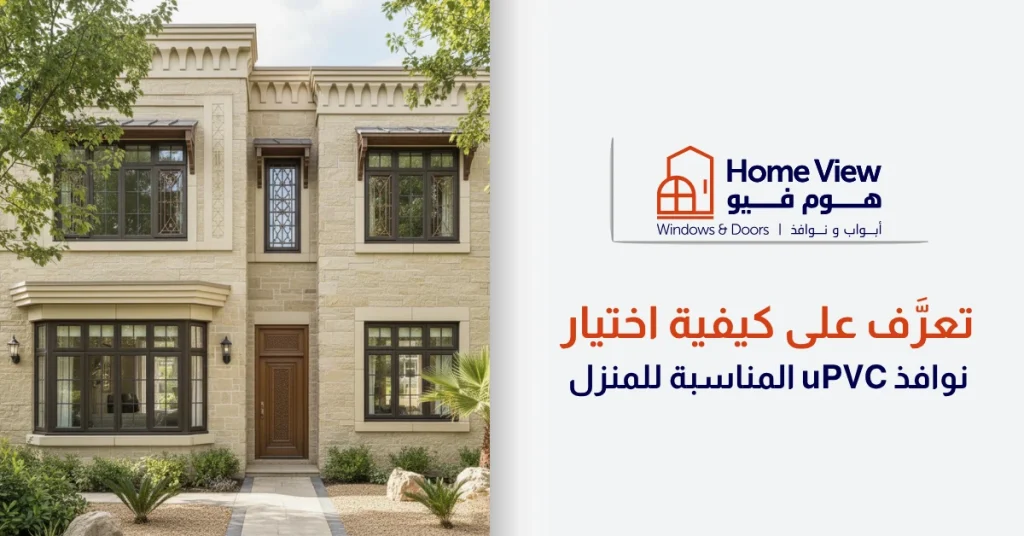
In a modern Saudi home, the morning sunlight caresses you through an insulating window that protects you from the summer heat and winter cold, adding elegance to your interior decor.
These windows, made of uPVC, combine the features of advanced materials. They block out most external weather factors to limit high air conditioning costs, while simultaneously allowing natural daylight to enter boundlessly!
In this article, we provide you with the most important practical tips for choosing the right uPVC windows for your home, in simplified ways that benefit from the expertise of the Saudi company Home View. So, let’s begin an enjoyable journey from start to finish.
How to Choose the Most Suitable uPVC Windows for Your Home?
It is not just about choosing between materials or style; it also involves important decisions such as correct measurements and window orientation.
All these crystalline factors directly affect energy efficiency, natural lighting, ventilation, and interior aesthetic appearance. If you miscalculate the measurements, for example, or ignore some technical details, it may result in unwanted negatives in the future, such as rainwater leakage or poor insulation.
In this comprehensive guide, the Home View team takes you hand-in-hand, step-by-step, to avoid common installation mistakes and apply best practices when choosing the right uPVC windows for your home, from a realistic and practical perspective—especially within a Saudi environment that requires a balance between performance, comfort, and consideration of climatic factors.
6 Tips for Choosing the Right uPVC Windows for Your Home
1- Measuring Windows with High Precision
The best window sizing starts with measuring the frame dimensions accurately (height, width, and depth). Do not rely on approximate estimates; a simple error in measurement may force you to modify the wall or change the window size later. Therefore, experts recommend using precise measuring tools (with an error margin not exceeding ±1 mm) when taking dimensions.
For this reason, it is preferable to request a field visit from a professional engineer or technician to take measurements according to approved standard criteria. This ensures the frame and joints are installed without gaps or excessive tension, maintaining insulation efficiency and ideal window performance.
2- Considering Sun Directions and the Saudi Climate
Given the hot, dry climate in summer and partially humid climate in winter in some Saudi regions, sunlight directions must be studied when choosing window locations. West-facing windows catch the strong evening heat, while south-facing ones are exposed to direct sun for most of the day!
Therefore, it is advised to employ external shades and choose windows with high-performance insulated glass for the facades. Engineers have noted that controlling the building’s orientation reduces heat transfer into the house and decreases air conditioning consumption by about 20-30%.
Take into account the view of each room—preferably facing the street—and pay attention to light sources when determining the window’s location and direction.
3- Advanced Thermal and Acoustic Insulation
One of the most important features of uPVC windows is their superior ability for thermal and acoustic insulation. Thanks to their “multi-chambered internal” design and tight, leak-proof gaskets (such as high-quality EPDM seals), these windows block about 90-95% of direct heat and provide sound insulation ranging between 35 to 50 decibels.
To ensure the best insulation, choose a frame with 5 chambers or more (each air chamber inside the frame improves insulation further) and double or triple glazing (with a Low-E layer that helps trap heat inside the glass).
Professional installation, using airtight silicone sealants, completes the system, making outside street noise very faint indoors.
4- Type of Glass Used
It is preferable to use double or triple-layered glass in uPVC windows. Double glazing contains two panes separated by a gas (like Argon), while triple glazing includes three panes; both raise thermal and acoustic insulation to record levels.
High-reflectivity (Low-E) glass is also recommended, which reflects ultraviolet rays, reducing the entry of high heat. When choosing glass, ensure that the outer lamination is transparent and shatter-resistant, as modern windows ensure durable and tightly fixed double glass layers.
5- Specifications for Frames, Handles, and Accessories
The Frame:
Choose a uPVC frame (profile) reinforced with galvanized steel bars within its cavities to increase durability and stiffness. These additional reinforcements in uPVC frames ensure window stability against strong winds and sandstorms common in Saudi Arabia. Furthermore, the multiple chambers in the frame (5-7 chambers) provide higher mechanical durability and reduce heat leakage.
Handles and Accessories:
These must be rust-resistant metal (stainless steel or coated) and support smooth opening/closing operations. It is preferable to choose multi-point locking systems to increase security and focus on hinge quality to ensure ease of operation.
Tight leak-proof accessories (EPDM gaskets) are also essential to prevent dust and external sound from seeping in.
6- Quality Standards and Certifications
Do not forget to verify manufacturing quality before purchasing. Base your choices on the presence of international standard certifications such as CE or ISO 9001 for the manufactured materials. Leading global factories (such as Deceuninck and Winsa) ensure these standards are met to guarantee dimensional stability, insulation efficiency, and the purity of the materials used.
Check for factory warranties (usually 5 years or more for German systems) and after-sales services in Saudi Arabia. The more a window is from a known brand and contains the aforementioned specifications, the higher the likelihood of its quality and performance remaining stable for years, even decades.
» Get a free consultation and a detailed price offer now from Home View via WhatsApp
What is the Difference Between uPVC Windows and Aluminum Windows?
When looking at the difference between uPVC windows and aluminum windows, we find that each has its advantages and disadvantages, but the differences are clear in some important aspects.
In terms of thermal insulation, uPVC windows clearly excel. The plastic frame is non-conductive and helps improve cooling efficiency, as insulation performance can reach excellent values between 0.8 – 1.2 W/m²K when using double glazing.
As for aluminum, it is a good conductor of heat, and without a thermal break, its heat transfer coefficient can exceed 2.5 W/m²K.
Regarding acoustic insulation, uPVC windows provide better performance due to their multi-layered design and sealing gaskets that reduce external noise. Meanwhile, aluminum offers average insulation and often requires double glazing and additional solutions to reach the same efficiency.
On the side of durability, aluminum is characterized by high structural strength and thin frames that withstand large glass weights, but it requires special treatments against rust and periodic repainting. In contrast, uPVC windows shine with excellent resistance to moisture, rust, and corrosion, and are unaffected by rain or UV rays.
In terms of maintenance, aluminum requires periodic follow-up for cleaning, oxidation treatment, and repainting when necessary. Meanwhile, uPVC maintenance is mostly limited to cleaning with soap and water.
As for cost, uPVC window prices are often lower than aluminum initially, although insulated glass may increase the cost. In contrast, aluminum windows come at a higher cost, ranging between 70% and 200% compared to uPVC, depending on the design and specifications.
Choosing the right type depends on your priorities. If thermal and acoustic insulation efficiency and reducing energy consumption are your goals, then uPVC is the ideal choice. However, if you are looking for very thin frames with high weight-bearing capacity, aluminum might be more suitable.
Common Mistakes When Installing Residential uPVC Windows
1- Incorrect Installation of Water Seal (Flashing)
One of the very common mistakes is negligence in installing the water sealant, known as flashing, which leads to water leaking through the frame.
2- Excessive Use of Expanding Foam
Some technicians use a large amount of it, which puts pressure on the uPVC frame and causes it to lose its shape or distort its working mechanism. The solution lies in using low-expansion foam, designed specifically for window installations. Use it sparingly to avoid increasing pressure on the frame, and always follow the manufacturer’s recommendations when using expanding foam.
3- Choosing Inappropriate Sizes
Taking accurate window measurements is very important. If the size is too large or too small, the expected thermal performance will decrease, ventilation will be ineffective, or natural lighting will be insufficient.
Best Practices for Choosing Size and Direction for uPVC Windows
1- Choosing Appropriate Sizes
It is recommended that windows cover about 10% of the room area as a rule of thumb to provide good lighting and ventilation without very large openings that harm insulation.
2- Standard Reference Window Sizes
Among common sizes: width ranging between 24 – 48 inches, and height from 36 – 72 inches, depending on the window’s design and function.
3- Determining Window Size According to the Room
In the kitchen, for example, it is preferred that the window height be no less than ~12 inches, and its width as well, with the aim of providing appropriate ventilation while maintaining safety and privacy.
4- Direction (Window Orientation)
If the window faces sunny directions (East or South), permanent shading or specialized glass must be considered to reduce heat gain; this is very important in the Kingdom’s climate to save energy.
Likewise, choosing the right size with orientation affects energy consumption and reduces the load on air conditioning if implemented correctly.
Conclusion, About uPVC Windows for Homes
Choosing the right uPVC window systems for your home requires attention to every detail, from correct measurements to the quality of glass, frame, and professional installation. By following these tips, you will enjoy a more comfortable and safe home, with a significant reduction in air conditioning and maintenance bills. However, we at Home View Saudi Arabia will spare you all that trouble…
We believe that the “modern window” must combine beauty and function; therefore, we are keen to provide advanced and integrated uPVC solutions simultaneously, with modern designs according to the highest quality standards.
Contact us now to receive a free consultation and a custom price offer, and let your home have the tranquility and insulation efficiency it deserves.
FAQs about Choosing the Right uPVC Windows for Your Home
What are the best types of uPVC windows?
The best uPVC window systems are those that contain insulated double/triple glazing, multi-chambered frames, and high-quality sealing gaskets.
These specifications (Low-E glass, gas spacers, EPDM gaskets) ensure the highest degree of insulation and efficiency; global systems like Deceuninck and Winsa usually come with these specifications as standard.
How do you know that uPVC windows are of good quality?
Quality is verified by examining the material and the factory; check if the frame is steel-reinforced and equipped with several chambers, if the glass is double or triple-layered, and if the gaskets are tightly sealed.
Also, look for certifications (CE/ISO) from the manufacturing company, and the extent of the warranty on quality and installation from the executing company. High-quality windows are weather-resistant and last 20 to 30 years on average, with consistent thermal and acoustic insulation capabilities throughout their lifespan.
Are uPVC windows better than aluminum in sound and heat insulation?
Yes, uPVC windows usually provide higher thermal and acoustic insulation than aluminum; the non-conductive plastic frame incorporates air chambers, whereas aluminum is a good conductor and requires additional insulating barriers.
Also, uPVC requires less maintenance and has lower installation costs. Aluminum is distinguished by thinner frames and higher load-bearing capacity, but it often needs thermal treatment and periodic protective coating to maintain insulation.
Choosing the ideal home windows depends on your needs. If insulation and energy calculations are a priority, then uPVC windows are definitely the optimal choice.
What is the best type of uPVC window?
There is no absolute “best type,” as it depends on the budget and your requirements. German systems (such as REHAU and VEKA) provide the best quality and long-term performance.
Turkish systems (such as Pimapen) combine good quality and a reasonable price. Chinese ones may be less expensive initially, but it is worth verifying their specifications (number of chambers, presence of certifications) before choosing.
At Home View, we help you choose the right system for your home based on quality standards and your specific needs.


